Close search
Popular searches
20 Aug 2026 UTC+8 views:
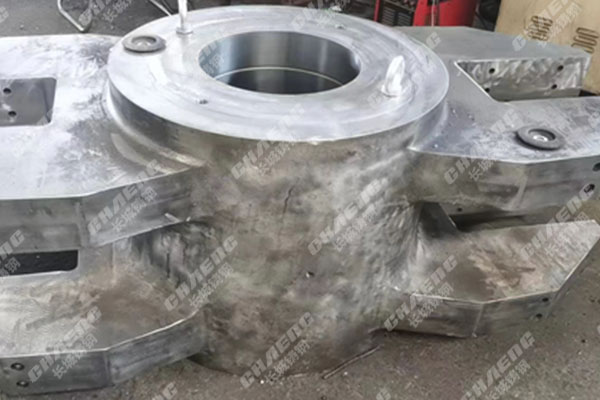
As the core load-bearing component of a ship's steering system, the tiller directly withstands complex alternating loads such as propeller thrust, water flow impact, and steering torque. Its smelting and casting quality is directly related to navigation safety. International classification societies (such as the China Classification Society [CCS], Det Norske Veritas [DNV], and Lloyd's Register [LR]) have established strict material standards and inspection specifications for marine cast steel parts. Domestic large-scale steel casting enterprises have continuously broken through process bottlenecks to provide marine cast steel parts that meet technical requirements for the shipbuilding industry. This article presents the technical pathways and practical experience of Great Wall Steel Casting's large-scale steel casting plant in enhancing the comprehensive performance of marine tillers—covering raw material optimization, smelting and refining processes, casting process control, heat treatment technology, and non-destructive testing—providing a reference for quality upgrading of similar products in the industry
.
1. Technical Requirements
Material Requirements:
Low-alloy high-strength cast steels such as G20Mn5 (excellent low-temperature toughness) and G24Mn6 are typically used. For some high-specification products, G26CrMo4 quenched and tempered cast steel is employed to meet higher strength and fatigue resistance requirements.
Non-Destructive Testing:
Ultrasonic Testing (UT) is performed in accordance with CCS Materials and Welding Regulations, with critical areas meeting Class I standards. Magnetic Particle Testing (MT) or Liquid Penetrant Testing (PT) is conducted to ensure the surface is free of linear defects.
2. Raw Material Quality Control
Great Wall Steel Casting uses high-quality scrap steel with low residual elements, strictly limiting the total content of residual elements such as Cu, Cr, Ni, Mo, and Sn (Σ residual ≤ 0.5%). A spectrometer is introduced for rapid pre-furnace testing of each batch of scrap steel, achieving precise burden proportioning, reducing harmful element content at the source, and ensuring the cleanliness of the cast steel matrix. All ferroalloys (ferromanganese, ferrosilicon, ferromolybdenum, etc.) must undergo incoming inspection and can only be warehoused for use after their chemical composition is verified as qualified.
3. Optimization of Smelting and Refining Processes
Large-scale steel casting plants generally use three-phase AC electric arc furnaces for primary smelting. The main optimization directions include:
Deep Dephosphorization in the Oxidation Period:
By controlling slag volume and basicity (R = CaO/SiO₂ = 3.0–4.0), maintaining a high furnace temperature (1580–1620°C), and intensifying oxygen supply, the phosphorus content of the molten steel is reduced to P ≤ 0.012% before tapping, providing a low-phosphorus foundation for subsequent refining.
Carbon Content Control:
An appropriate oxidized carbon content (C ≥ 0.05%) is retained to promote natural stirring of the molten steel by CO bubbles, effectively removing hydrogen and inclusions.
Tapping Temperature Management:
The tapping temperature is set according to casting wall thickness and pouring volume, typically controlled at 1620–1650°C, to prevent grain coarsening caused by overheating.
4. Heat Treatment Process
Heat treatment is the key process that determines the final mechanical properties of the tiller. The commonly used process is quenching and tempering (Q&T). For tillers with complex shapes and significant wall thickness differences, normalizing is first performed after casting (G20Mn5: holding at 860–880°C followed by air cooling) to relieve casting stress, homogenize the microstructure, and refine grains, providing a sound microstructural basis for subsequent quenching and tempering.
5. Quality Inspection and Certification
Ultrasonic Testing (UT):
A full-section UT scan is performed on the casting, focusing on the root of the tapered hole, section transition zones, and areas near hot spots. Per the EN 12680-3 standard, general areas shall meet no less than Level 3 and critical areas no less than Level 2.
Magnetic Particle Testing (MT):
MT inspection is conducted on the casting surface and near-surface areas; no linear indications are permitted.
Chemical Composition and Mechanical Property Verification:
Samples are taken from each heat of molten steel for full spectral analysis to ensure the composition complies with the corresponding material standards. Attached test blocks are cut from the casting for tensile, impact (including −20°C low-temperature impact), and Brinell hardness tests. All indicators must meet the requirements of classification society regulations such as CCS and DNV.
Third-Party Classification Society Verification:
Steel casting plants should establish a normalized cooperation mechanism with major classification societies, inviting classification surveyors to participate in witnessing key processes throughout (smelting sampling, heat treatment, etc.), ensuring that products obtain classification society material approval certificates and enhancing the international competitiveness of products.
6. Digital Simulation and Process Optimization
The application of casting simulation software is shifted forward from process design to the R&D stage, enabling virtual verification for new product development and new material trial production, shortening the process development cycle, and reducing trial production risks and rejection rates.
Enhancing the smelting and processing technology of marine cast steel tillers is a systematic project encompassing raw material control, refining metallurgy, casting processes, heat treatment, and non-destructive testing. Great Wall Steel Casting has been deeply engaged in the marine cast steel parts field for many years, possessing full-process production and classification society certification capabilities for tillers of various materials such as G20Mn5, G24Mn6, and G26CrMo4. Its products are widely used in various large vessels such as bulk carriers, oil tankers, and container ships. By promoting LF+VD ladle refining technology, strengthening digital simulation of the casting process, optimizing heat treatment regimes, and controlling machining precision, Great Wall Steel Casting can effectively reduce casting defect rates, significantly improve the comprehensive mechanical properties and metallurgical quality of products, and meet the stringent certification requirements of major international classification societies.
----- END -----