Close search
Popular searches
24 Aug 2026 UTC+8 views:
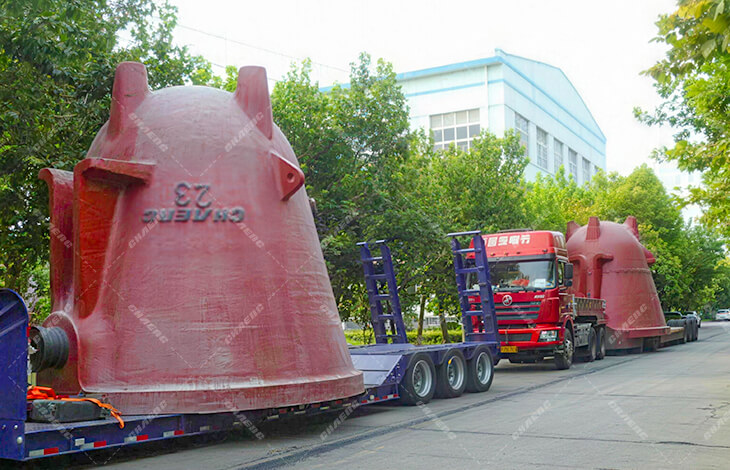
Large frame (machine frame) production is one of Changcheng Cast Steel's main products, accounting for one-third of the company's annual production for nearly 10 consecutive years. The company currently has the capacity to produce frame (machine frame) products with a gross weight of less than 300 tons. Through long-term production of similar products, and by continuously optimizing and improving the casting process based on past quality issues and production verification, the casting process for large frame (machine frame) has become increasingly mature and stable. This has solidified into our stable casting process, reducing the workload of finishing after rough machining of the frame (machine frame), ensuring product quality while improving delivery time and customer satisfaction.
The rolling mill stand (frame) is a key component of the coil rolling mill in the metallurgical industry. It is typically produced in pairs, divided into an operating side and a drive side. Its internal quality requirements are high, mainly falling into two categories: one requires 100% ultrasonic Class II flaw detection for the entire stand (frame); the other requires ultrasonic Class II flaw detection for the entire outer layer of the inner cavity, with the remaining parts requiring Class III. The stand (frame) structure is relatively simple, and the material is not special, generally ZG270-500 or ZG230-450. In the early days of our company's production of these products, we frequently encountered quality issues with ultrasonic testing exceeding standards, and later, we experienced quality problems with sand and air holes on the upper surface. However, through our understanding of product structure, process optimization, and on-site production tracking services, we have taken some corresponding process adjustment and optimization measures to gradually overcome and resolve these quality issues, continuously improving the quality of products such as archways (frames). After the rough processing of the products, ultrasonic testing (UT), magnetic particle testing (MT), and penetrant testing (PT) have been carried out, and the product quality has been improved to varying degrees. We have also solidified some mature and effective measures, forming a stable production process for archway (frame) products within the company.
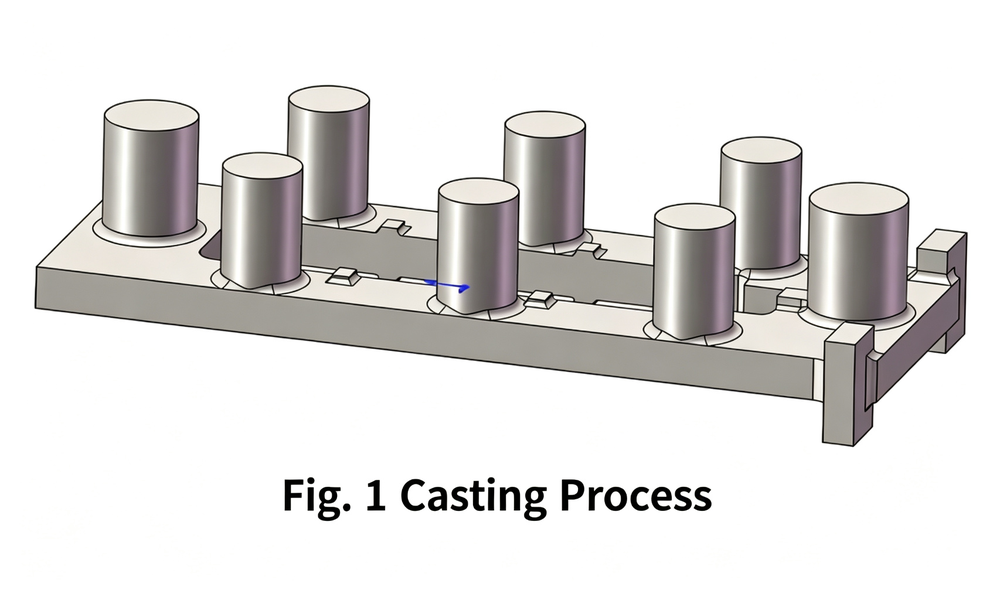
1. Casting Process Selection Based on the specific structure of the archway (frame) product, there are three main casting process options: the first is a full sample casting process, the second is a full core assembly casting process, and the third is a partial sample casting process plus core assembly. Each foundry can choose the casting process option suitable for its own production process. Based on our years of experience in producing archways (frames), we have adopted the third process option,
as shown in Figure 1.
2. Quality Assurance in the Casting Process: The structure of the frame (machine frame) is simple, and quality problems are generally not too serious. However, they are all thick and large parts. The thickness of the frame (machine frame) of 50 tons or more is basically over 400mm. It is quite complicated to deal with quality problems. Preheating is required, and stress relief is required after treatment, which increases the production cost of the company. Therefore, we should try to minimize the occurrence of quality problems for these thick and large parts. Based on our company's many years of experience in producing frame (machine frame), the quality problems of frame (machine frame) are basically ultrasonic defects, upper surface defects, cracks, and deformation. Through years of production experience accumulation and process optimization, our quality is becoming more and more guaranteed, and the entire production cycle has been shortened by about 5 days.
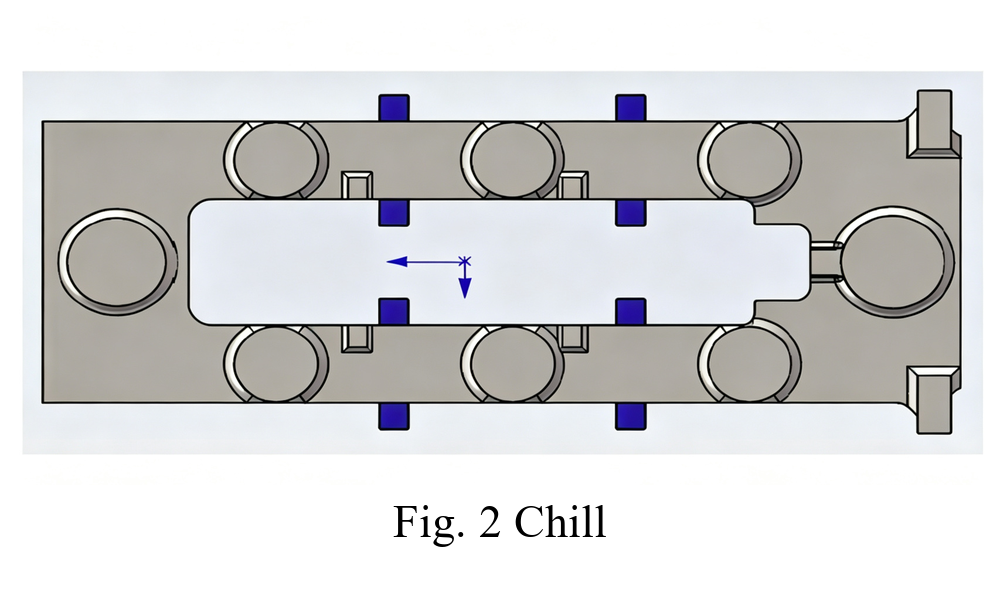
(1) Ultrasonic Defect Problems: If ultrasonic defects are present, they generally appear in the part between the two risers on the column. From the perspective of casting process, the column of the frame (machine frame) is a rod-shaped structure with a short feeding distance and slow cooling. If the end cooling between the two risers is not good, shrinkage defects are likely to occur. Even if the feeding distance is sufficient, if the end cooling intensity is insufficient, ultrasonic defects will still occur. How to strengthen the end cooling between the risers is the key point of process consideration. Methods to enhance cooling at the ends of the risers between the columns of the archway (frame) generally include internal chills, external chills (as shown in Figure 2), or a combination of both. When using internal chills, the size of the round steel must be considered, and it must be securely fixed to prevent the molten steel from being scattered and shifted. When using external chills, the thickness of the external chills and the thickness of the sand coating must be considered. Insufficient thickness of the external chills can also cause ultrasonic defects. Based on our company's many years of experience, the thickness of the external chills should be at least 80% of the thickness of the column.
(2) Surface Defects: The main surface defects of the archway (frame) are sand pores and inclusions. Structurally, the upper surface of the archway (frame) is a large plane. The large volume of molten steel filling the mold during the casting process, coupled with the long casting time, results in a long baking time for the upper surface and a high probability of sand loss. Firstly, the strength of the sand mold in the face box (core cover) must be guaranteed; secondly, the strength and erosion resistance of the sprue bricks must be ensured, guaranteeing that the sprue surface remains intact after casting and erosion; finally, further measures should be taken to reduce surface defects, such as adding sand collection plates to areas prone to sand pores or inclusions; and adding sloping shoulder protrusions to all risers to facilitate defect floating and extend the riser feeding distance.
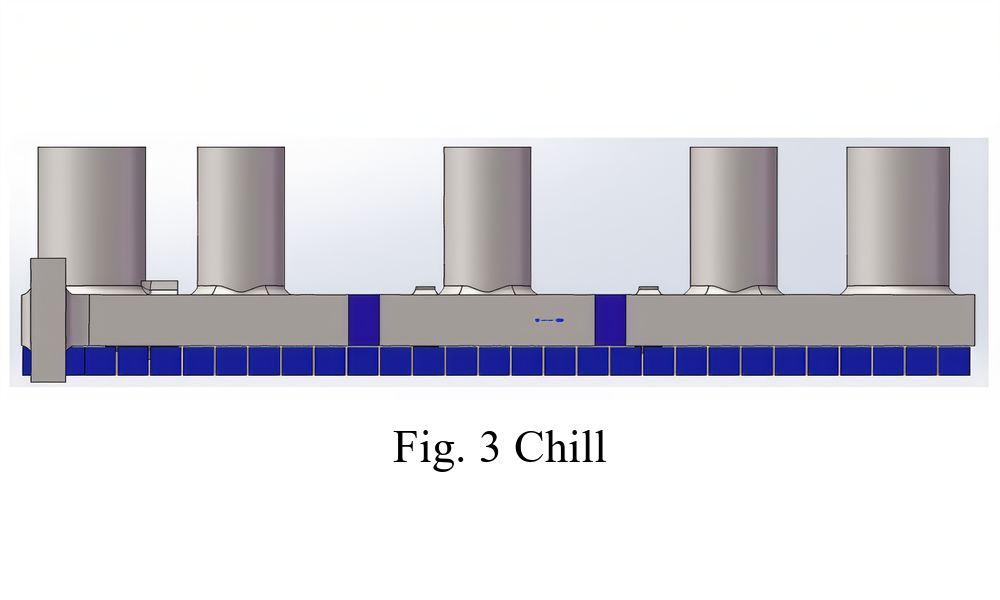
(3) Cracks: Cracks in the archway (frame) mainly appear on the lower surface and at the rounded corners of some bosses. Analysis indicates that these cracks are all hot cracks. Our early process only used external chills between the risers. After the products were processed, ultrasonic or magnetic particle testing revealed discontinuous cracks in the center of the lower surface. These cracks were shallow, about 30mm deep, and all needed to be removed. Through trial and error, our current process uses segmented external chills on the entire lower surface of the frame (as shown in Figure 3). This eliminates cracks on the lower surface and also allows for a reduction in riser size, improving product yield. The elimination of cracks at the rounded corners is achieved through standard process design with anti-crack ribs.
(4) Deformation problem The deformation of the archway (frame) is the deformation in the length direction. The length of small archways (frames) is four or five meters, most are between six and ten meters, and those exceeding 150 tons are all over ten meters long. The machining allowance for such long castings is only 30mm, so the deformation must be controlled within 10mm so that the archway (frame) has rough machining allowance and fine machining allowance to meet the machining requirements. Measures to prevent deformation should be considered from several aspects. First, the shape should consider a hard sand bed to ensure the strength of the ground or, as mentioned in (3), the lower plane should be fully equipped with external chills to ensure the strength of the plane. Second, when pre-cutting the riser in the casting state, the archway (frame) columns need to be leveled to reduce the deformation caused by long cutting time and uneven heating. Third, when officially cutting the riser after heat treatment, the archway (frame) columns still need to be leveled as they were when cutting in the casting state. Only by taking measures in these aspects can the deformation along the length of the archway (frame) be effectively controlled, ensuring that both the upper and lower surfaces of the archway (frame) have appropriate machining allowances.
3. Conclusion The archway (frame) structure is simple, and the casting process is not complex. While the quality problems encountered by different foundries may vary, the underlying principles are the same. By continuously optimizing process plans and skillfully analyzing and summarizing experiences, product quality will improve, leading to lower production costs for the company. Ultimately, meeting customer needs in terms of delivery time is crucial for achieving customer satisfaction.
----- END -----