Close search
Popular searches
11 Aug 2026 UTC+8 views:
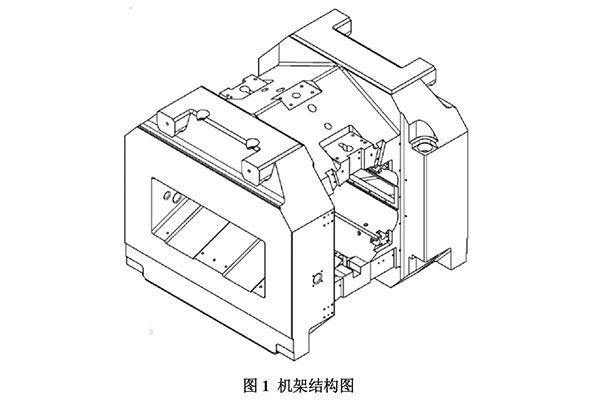
The Sendzimir mill is one of the core pieces of high-precision rolling equipment, mainly used for rolling cold-rolled stainless steel strip. It consists of a stand, roll system, roll box, pressing device, and drive unit. The stand's internal cavity is shaped like a quincunx, hence the name "quincunx stand." This unique structural design ensures that the rolling force acts radially across all sections of the stand, providing stable support for the work rolls along their entire length, playing a crucial role in the Sendzimir mill. The 1450mm twenty-roll mill stand produced by Xinxiang Changcheng Cast Steel Co., Ltd. has main dimensions of 2575mm × 2440mm × 2380mm. Due to its large size, thick walls, and strict quality requirements, its structure is shown in Figure 1.
1. Casting Material, Structure, and Flaw Detection Requirements
1.1 Chemical Composition and Mechanical Properties


1.2 Quality Inspection Requirements
1.2.1 Casting dimensional tolerances shall conform to JB/T5000.6-2007 standard CT13 level.
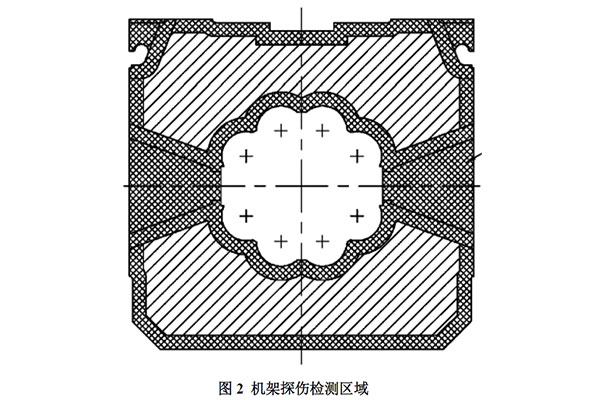
1.2.2 The frame shall undergo ultrasonic testing. Within 100mm, the testing level shall not exceed level 2 as specified in JB/T5000.14-2007; beyond 100mm, the testing level shall not exceed level 3 as specified in JB/T5000.14-2007 (see Figure 2). The machined surfaces of the workpiece shall be colored to level 2. Finishing to 1mm, the perforated holes shall undergo magnetic particle testing. Defects affecting strength and appearance, such as cracks, porosity, air holes, and sand holes, are prohibited.
1.2.3 Additional Requirements: No internal chills may be placed inside the mold cavity.
1.3 Frame Structure and Process Challenges
1.3.1 The frame structure is thick and large, with heat points concentrated at the four corners, resulting in a relatively dispersed heat distribution. Simultaneously, its heavy weight and concentrated sand core make heat dissipation difficult, easily leading to sand adhesion and shrinkage cavities and porosity defects.
1.3.2 The material inlet and outlet positions on both sides taper from the outside towards the center of the perforated hole, gradually narrowing. At the narrowest point inside, iron-clad sand easily forms, and improper handling of this defect carries the risk of cracking.
1.3.3 The perforated hole requires high precision, resulting in almost zero defects.
2. Casting Process Scheme
2.1 Selection of Parting Surface and Model Scheme
Based on the frame structure, the plum blossom hole faces upwards, and the conical triangular holes are located on both sides. The parting line is located at the center of the upper and lower parts of the casting. The model shape uses a 1/2 scale model, with the upper and lower boxes sharing the same model. The different parts are handled differently. The draft angle is 1:50. The plum blossom hole and the two conical triangular holes are used to form a core box, and the core head is carried out by the model.
2.2 Riser Design
Traditionally, two risers are used. Considering the casting's weight of approximately 72 tons and a large hot spot (φ900), a single riser is designed based on the principle of centralized feeding for thick and large castings. This riser is placed directly above the plum blossom hole, with a feeding channel (the channel thickness must be ≥ the largest hot spot) below it to meet the feeding needs of each hot spot. Placing the riser directly above the plum blossom hole also avoids potential quality risks to the frame caused by shrinkage cavities or porosity. Based on the 3D modeling in SolidWorks, the maximum module of the casting was calculated. For the same volume, a spherical riser offers the highest feeding efficiency and is the ideal riser shape. Considering sand removal and venting within the mold cavity, and given the casting's near-square shape, a cylindrical riser with a covering agent was chosen as the next best design option after the spherical riser. A φ1500 insulating riser was selected based on module calculations.
2.3 Gating System Design
For large cast steel parts, to maintain stable filling, the upper molten metal temperature is higher than the lower temperature after filling, facilitating sequential solidification and riser feeding. This results in a denser casting structure and avoids casting defects such as shrinkage cavities and porosity. A stepped gating system is generally preferred. The machine frame adopts a stepped open gating system with 8 ingates distributed in each layer. φ80 high-alumina refractory runners are used. To ensure stable filling, the first layer of ingates enters from the bottom, and the upper layer enters from both sides. Two layers of φ100 refractory runners are used for the horizontal runner, and φ120 refractory runners are used for the vertical runner. A single φ100 refractory runner is placed in the middle of the riser for later dedicated spot pouring.
2.4 Other Process Parameters
Due to the draft angle of the casting mold, the machining allowance is 20mm on each side of the outer shape, 25mm on each side of the top and bottom surfaces, and 30mm on each side for the perforated holes (due to stricter requirements). Since the casting is relatively thick and large, a 2.2% reduction in size is chosen. The pouring temperature is 1540-1550℃. A 300×300mm external chill is placed in the lower mold to artificially compensate for the shrinkage at the ends.
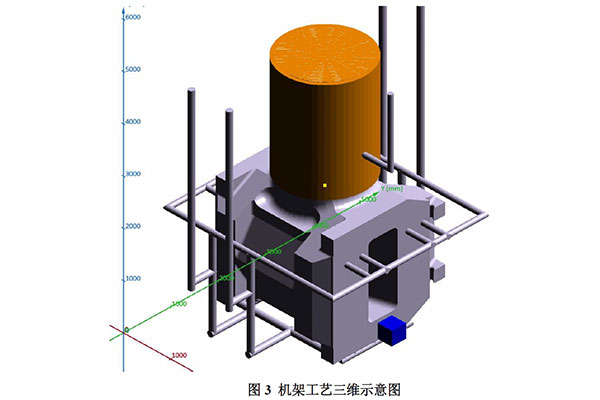
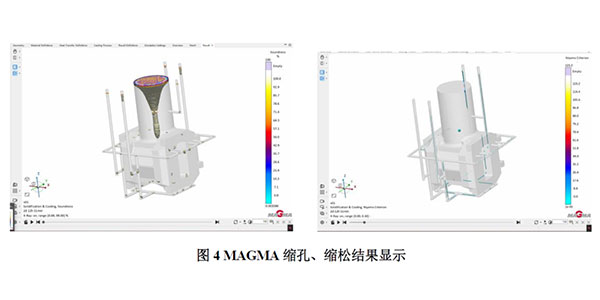
2.5 Solidification Simulation Analysis Changcheng Cast Steel was modeled using SolidWorks 3D software and simulated using MAGMA software. The simulation results show that there are no quality defects in the main body, and shrinkage cavities and porosity are concentrated inside the riser and are at a certain safe distance from the riser under the feed.
3. Casting Production Practice
3.1 Molding and Pouring
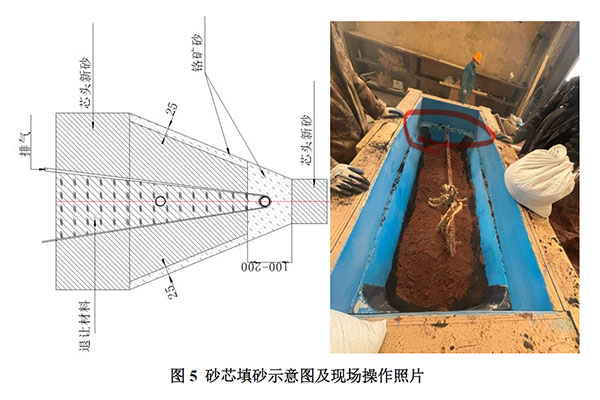
The casting was molded in a pit using a hard sand bed. A perforated steel pipe wrapped with straw rope was embedded at the bottom for venting. Considering the casting's thickness, the surface was coated with chromite sand (>10mm thick), while the rest of the main body was filled with water glass quartz sand. To avoid iron-clad sand defects in the conical triangular cores on both sides, molding sand was filled according to Figure 5, with chromite sand at the sharp corners ≥100mm thick and compacted. The cavity and sand core surfaces are coated three times with zircon powder alcohol-based paint. After the mold is closed, a 90t weight of pressurized iron is used and secured to prevent the mold from lifting. The total amount of molten steel is 109 tons, poured simultaneously in two ladles. During the first pour, the riser rises 300mm above the highest point of the casting before adding the covering agent. The riser is 800mm away from the casting. After the first pour, personnel are assigned to ignite and prim the gas in the venting channel. Simultaneously, a second smelting is carried out. The molten steel used in the second smelting can have a ZG230-450 composition and be poured at the highest possible temperature through a dedicated riser gate. After pouring, sufficient covering agent is added to the riser, and the riser is continuously tamped with a wooden stick to prevent a vacuum from forming at the top of the riser and to improve feeding efficiency.
3.2 Cleaning and Heat Treatment
After the frame has been kept at room temperature for 8 days, it is unpacked. The risers are pre-cut using the residual heat, with a pre-cut riser height ≥200mm. After gas cutting, the risers are left to stand for >24 hours. The casting is then transferred, and the surface and internal molding sand, gates, and other excess materials are removed (if there is a defect of iron-clad sand, subsequent heated treatment is required). The entire casting is then placed in the furnace for heat treatment. The heating rate is <80℃/h, reaching 910±10℃, and held for 28 hours before being removed and air-cooled. Once the casting has cooled to 300℃, the pre-cut risers and internal perforated holes are cut. The cutting process must not be interrupted. After cutting, the casting is immediately placed in the furnace for tempering at 610±10℃, held for 24 hours, and removed from the furnace when the temperature is below 300℃ for air cooling.
3.3 Production Verification
The composition and performance of the frame body produced according to the above scheme are shown in the table below.


The frame was found to be free of adhering sand on the surface and iron-clad sand inside. After rough machining, ultrasonic testing by the customer confirmed it fully met the drawing requirements. The chemical composition and performance met the requirements, and the overall quality was highly praised by the customer. Subsequent production of dozens of similar Sendzimir mills proceeded without major quality issues, laying a solid foundation for the company's development.
4. Conclusions
1) The centralized feeding design of the riser, combined with MAGMA software simulation, effectively ensured the internal structure of thick and large parts, effectively guaranteeing the quality of casting flaw detection.
2) The rational use of sand types effectively avoided sand adhesion in thick and large parts and iron-clad sand defects that are difficult to cast.
3) Utilizing process temperature to cut the riser saves costs and avoids the cracking risk associated with cutting large risers.
4) Valuable experience was provided for the subsequent production of similar Sendzimir mill frame products.
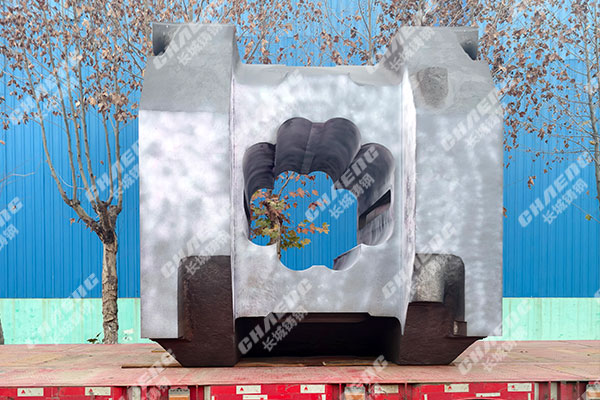
Xinxiang Changcheng Cast Steel Co., Ltd. has a single-piece casting capacity of up to 350 tons and an annual casting capacity of 100,000 tons. As a large-scale cast steel enterprise, we have extensive experience in casting and processing 20-roll mill stands. For those with such needs, please feel free to contact us for a free quote.
----- END -----