Close search
Popular searches
20 Sep 2026 UTC+8 views:
Main saddles, splay saddles and cable bands are among the most safety-critical steel castings on a suspension bridge: they carry and redirect the main cables of the entire structure for decades of service. Choosing the right casting supplier — and the right material grade — directly determines the fatigue life and safety of the bridge. In this guide, CHAENG (Great Wall Steel Casting) explains the five points that matter most when sourcing saddle and cable band castings.
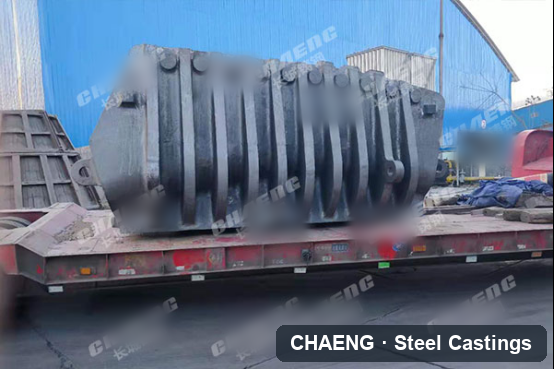
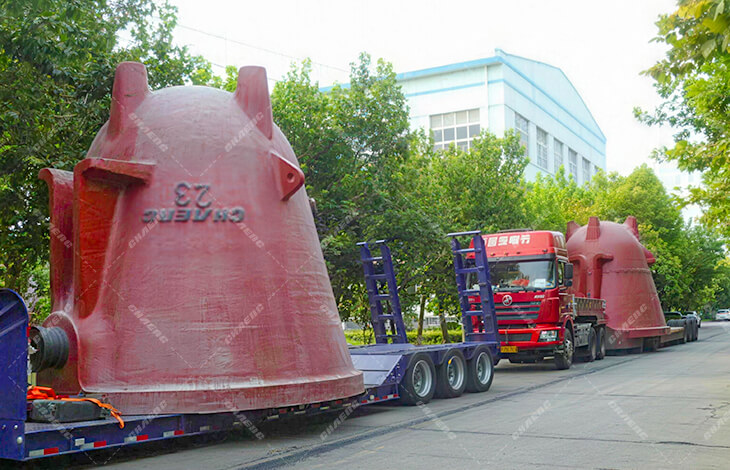
CHAENG-cast main saddle ready for shipment
CHAENG operates 300-tonne-class molding and box-assembly capacity for large steel castings, allowing main saddles, secondary saddles and splay saddles of 30–60 tonnes per piece to be cast in one pour. Why does this matter? Because a one-piece casting eliminates welded joints altogether — and weld seams are precisely the weak points that reduce the fatigue life of load-bearing components. For bridge structures designed for 100-year service lives, an integral casting is a decisive advantage.
Saddle and cable band castings are commonly supplied in grades such as ZG270-480, ZG310-570, G20Mn5, G24Mn6, G26CrMo4, E300-520 and E370-620. CHAENG supplies according to the customer's drawing and specified grade, with chemical composition and mechanical properties complying with EN, GB, ASTM and other standards. Whether your project follows European practice (G20Mn5, G24Mn6 per EN 10340) or Chinese standards, the material certificate will match your specification.
Every casting undergoes normalizing + tempering or quenching and tempering (Q+T). This relieves casting stresses and stabilizes the microstructure, ensuring uniform low-temperature impact energy at −20 °C / −40 °C and uniform cross-sectional hardness — exactly what the main cable system of a suspension bridge requires for low-temperature service.
CHAENG works on an "according to your drawing" basis: castings are delivered as rough blanks or pre-machined parts, and both single-piece small batches and large-volume orders are welcome. From molding, melting, heat treatment and machining to logistics, the whole process is delivered one-stop.
When comparing quotations for suspension bridge saddle and cable band castings, check five things: single-piece casting capacity (weld-free construction), the available material grade system, integral heat treatment capability, NDT coverage (UT + MT on 100% of the casting), and the flexibility of the quotation model. CHAENG checks all five boxes.
Looking for a reliable steel castings manufacturer for your suspension bridge project? Send us your drawing for a customized quotation.
----- END -----